
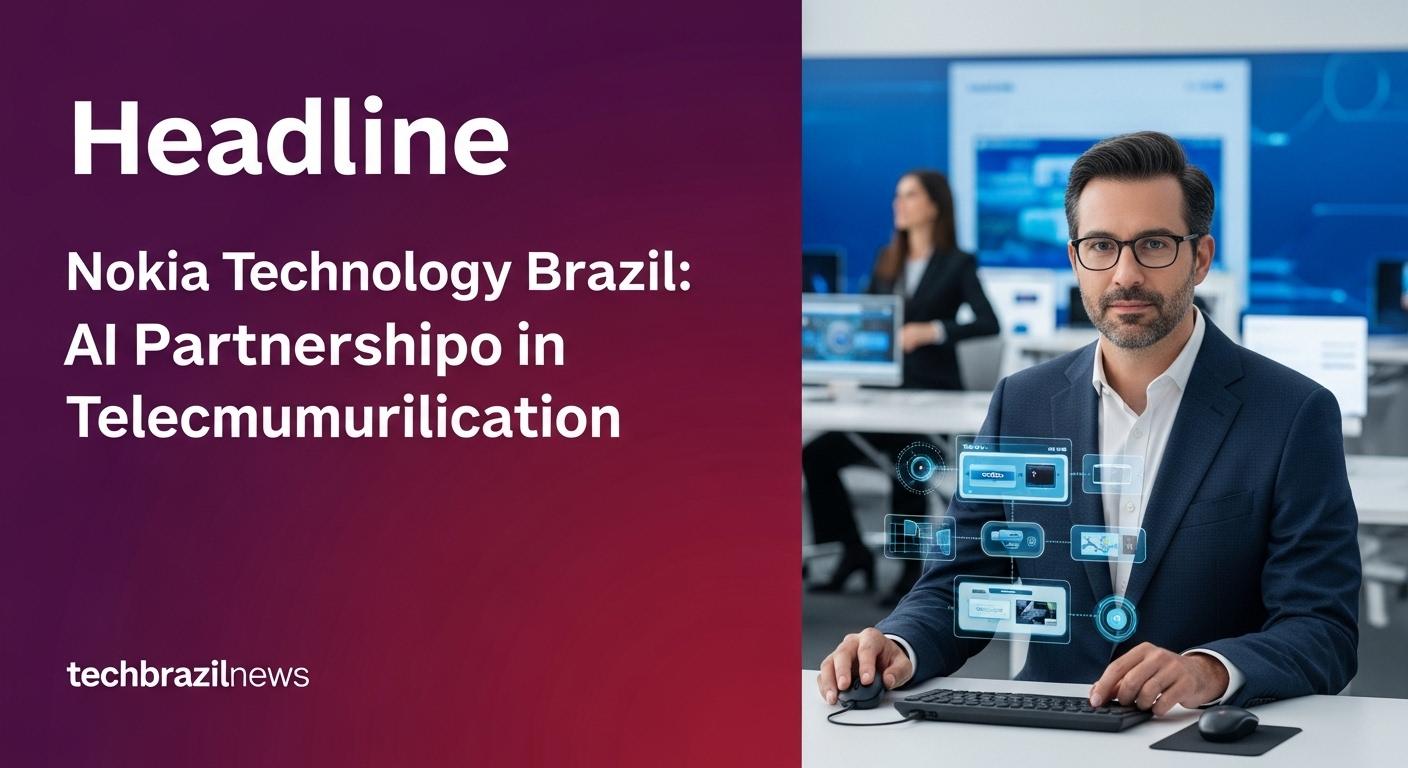
nokia Technology Brazil is stepping into a broader role in Brazil’s digital infrastructure as it expands partnerships with TIM Brasil and Deutsche Telekom to accelerate AI-powered network capabilities. The move comes as Brazil intensifies 5G deployment, digital services demand, and a push to develop local AI talent. By tying European technology strength to Brazilian operators, nokia Technology Brazil aims to streamline operations, accelerate service restoration after outages, and enable new business models for enterprise customers. The storyline is not merely about faster networks; it is about translating AI-enabled efficiency into tangible improvements for consumers, small businesses, and regional logistics in a country poised between vast urban markets and underserved rural corridors.
Context: Nokia’s Brazil AI push within an evolving telco landscape
At the core, Nokia’s strategy in Brazil leverages AI-driven network automation, edge computing, and intelligent analytics to optimize heterogeneous networks that mix legacy infrastructure with modern 5G cores. TIM Brasil, a leading mobile operator in the country, has long sought to balance price competitiveness with high-quality service; Deutsche Telekom, already a major player in Europe, brings a tested playbook for network orchestration and AI-enabled fault management. Together, these partnerships suggest a blueprint for cross-border collaboration where European network software and hardware capabilities are deployed to accelerate Brazilian operators’ operational maturity.
Brazil’s regulatory environment and data-protection framework shape how AI can be used on public networks. The General Data Protection Law (LGPD) and sector-specific guidelines require careful governance of how subscriber data is collected, stored, and analyzed. Nokia’s involvement in local deployments hints at a model where data governance, localization, and cybersecurity are integrated into the rollout rather than treated as add-ons. The practical outcome, if implemented prudently, could be more resilient networks, shorter mean time to repair, and better QoS (quality of service) metrics in critical urban and industrial corridors. Yet the complexity of Brazil’s geography, with dense metropolitan zones and remote areas, means AI-enabled optimization must be piloted with careful documentation of outcomes and clear fiduciary responsibilities among partners.
Beyond the technology itself, the partnerships illuminate a broader trend: international vendors are seeking closer alignment with Brazilian operators to accelerate local capabilities and reduce reliance on single-sourcing. For Nokia, the emphasis on AI-enabled performance gains can translate into more predictable service levels and a stronger competitive edge in a crowded market. For TIM Brasil and Deutsche Telekom, the gains range from reduced outages to a richer data foundation for new services, including private networks and enterprise-grade automation in sectors such as manufacturing and logistics.
Implications for operators, vendors, and the Brazilian market
The practical implications of this AI-forward collaboration extend across multiple layers of the Brazilian telecom ecosystem. For operators, the focus is on enhancing network resilience and customer experience through real-time analytics, predictive maintenance, and automated fault isolation. This translates into lower operational expenditures and faster issue resolution, which can, in turn, justify more aggressive network expansions in underserved regions, provided the business case remains airtight. For vendors, the Brazilian market presents an opportunity to translate global AI and cloud-native software capabilities into localized deployments that respect data sovereignty and local content rules. The result could be a mixed ecosystem where Nokia’s AI tools operate alongside other vendor stacks, minimizing the risk of vendor lock-in and enabling operators to tailor solutions to specific regional needs.
For Brazilian businesses and consumers, AI-powered networks can unlock better performance in daily use—faster streaming, more reliable video calls, and steadier connectivity in public spaces and enterprise campuses. Enterprises stand to benefit from private network options, edge processing for industrial applications, and networking-as-a-service models that lower the barrier to adopting digital tools. This could spur a wave of data-driven optimization across sectors like logistics, agriculture, and urban services, as operators provide the reliable connective tissue for IoT devices and smart infrastructure.
On the regulatory front, the collaboration underscores the need for clear governance of AI in telecom environments. Regulators will likely emphasize transparency around data flows, model reliability, and security protocols. In a country with rapid digital adoption, this creates an opportunity for Brazil to establish a practical AI-telecom standard that protects privacy while enabling innovation. The challenge lies in balancing speed with accountability, ensuring that AI enhancements do not outpace the oversight framework designed to protect consumers and critical information networks.
Governance, data, competition, and future scenarios
As Nokia deepens its Brazil-based AI efforts, governance becomes a central theme. Data localization requirements, cybersecurity standards, and auditable AI decision-making are not mere compliance boxes; they shape how quickly networks can be upgraded and how securely AI components can be integrated into core and edge facilities. For incumbent operators, a multi-vendor approach remains prudent to avoid dependencies and to hedge against single-vendor risk. Nokia’s partnerships with TIM Brasil and Deutsche Telekom could push the market toward standardized AI interfaces and shared benchmarks, enabling smoother interoperability across networks and devices. That said, competition will intensify as other global players, local integrators, and cloud providers explore similar AI-enabled strategies, potentially accelerating innovation but also intensifying price and performance pressures.
Looking ahead, several scenarios emerge. In a best-case trajectory, AI-enabled networks deliver measurable improvements in latency, throughput, and energy efficiency, enabling broader rural coverage and more robust industrial private networks. The Brazilian economy could see faster digital transformation in manufacturing, logistics, and public services, with AI-driven optimization feeding into smarter city initiatives and public safety. In a more cautious scenario, regulatory constraints, integration challenges, or slower adoption of private networks could temper the pace of change, though fundamental improvements in network reliability would still accrue over time. A balanced view recognizes that Nokia’s Brazil effort is not only about catching up with global tech trends but about shaping a contingent, locally governed adoption path that aligns with Brazil’s unique market dynamics and policy environment.
Actionable Takeaways
- Public policymakers should establish clear, stable guidelines for AI in telecoms, emphasizing data protection, security, and transparent governance to foster trust and accelerate responsible innovation.
- Brazilian operators should pursue pilot programs that demonstrate concrete QoS gains, with published metrics to build a scalable business case for AI-enabled network modernization.
- Vendors and system integrators should adopt modular, interoperable AI tools that can operate in multi-vendor environments, reducing risk and expanding local capacity-building opportunities.
- Enterprises interested in private networks should map use cases and data requirements early, coordinating with operators to align with regional regulatory expectations and local titling of spectrum resources.
Source Context
For background on Nokia’s public moves with TIM Brasil and Deutsche Telekom in AI technology, see the Reuters coverage of the partnerships and AI push in the Brazilian market: Reuters coverage of Nokia TIM Brasil and Deutsche Telekom AI push.
Analyses and broader context on Nokia’s partnerships, and the technology push within the wider telecoms industry, are also discussed in coverage from TradingView: TradingView coverage of Nokia’s partnerships.
Additional context on Brazil’s innovation ecosystem, including green tech and energy transition research, is covered by CPG Click Petróleo e Gás: Brazilian energy transition and green hydrogen research.


